By

Somewhere between the last of the fairy lights and the first of the real exams, the room has to grow up. Most teenage girl bedroom ideas treat that as a decorating problem, a colour palette, a bedside table, some wall art. In an Australian second bedroom it is an arithmetic problem, and the arithmetic has an answer most bedroom ideas for teenage girls will not give you: in a standard 3m x 3m room, you can have a queen bed or a working desk. Not both.
Start with the tape measure, not the mood board
Across 23 published floor plans from two builders selling across the country, secondary bedrooms run 2700-3200mm wide by 2700-3500mm long 7.3 to 10.5 square metres. The NSW Apartment Design Guide sets the floor at 9m² for “other bedrooms (excluding wardrobe space)” with a “minimum dimension of 3m”. The 3.0 x 3.0m room everyone plans around is not the average Australian teen bedroom. It is the generous end of it.
The National Construction Code says less than you would expect. A bedroom is a habitable room: 2.4m ceiling (Housing Provisions 10.3.1), glazing equal to 10% of floor area (10.5.1), openable ventilation equal to 5% (10.6.2(a)) and no minimum floor area at all. In a 9m² room that is 0.90m² of glass and 0.45m² that opens: one window, which with the door and the robe leaves a single clear wall for everything else to fight over.
What fits in a 3m x 3m room
A sliding built-in wardrobe eats 650-700mm of width before any furniture arrives. Push the bed against one wall and this is the aisle you have left:
| Bed | Width | Clear aisle | With a 600mm desk in it |
|---|---|---|---|
| Queen | 1530mm | 820mm | 220mm |
| Double | 1370mm | 980mm | 380mm |
| King single | 1070mm | 1280mm | 680mm |
| Single | 920mm | 1430mm | 830mm |
Brisbane studio Zephyr + Stone puts the Australian minimum between two pieces of furniture at 600mm, comfortable at 750mm. The queen fails by 380mm. You cannot sit at that desk and you cannot walk past it. Move the desk to the foot wall and it is worse: 970mm behind a 2030mm mattress, minus a 600mm desk, leaves 370mm for a chair whose seat alone is 400-450mm deep. You cannot pull it out.
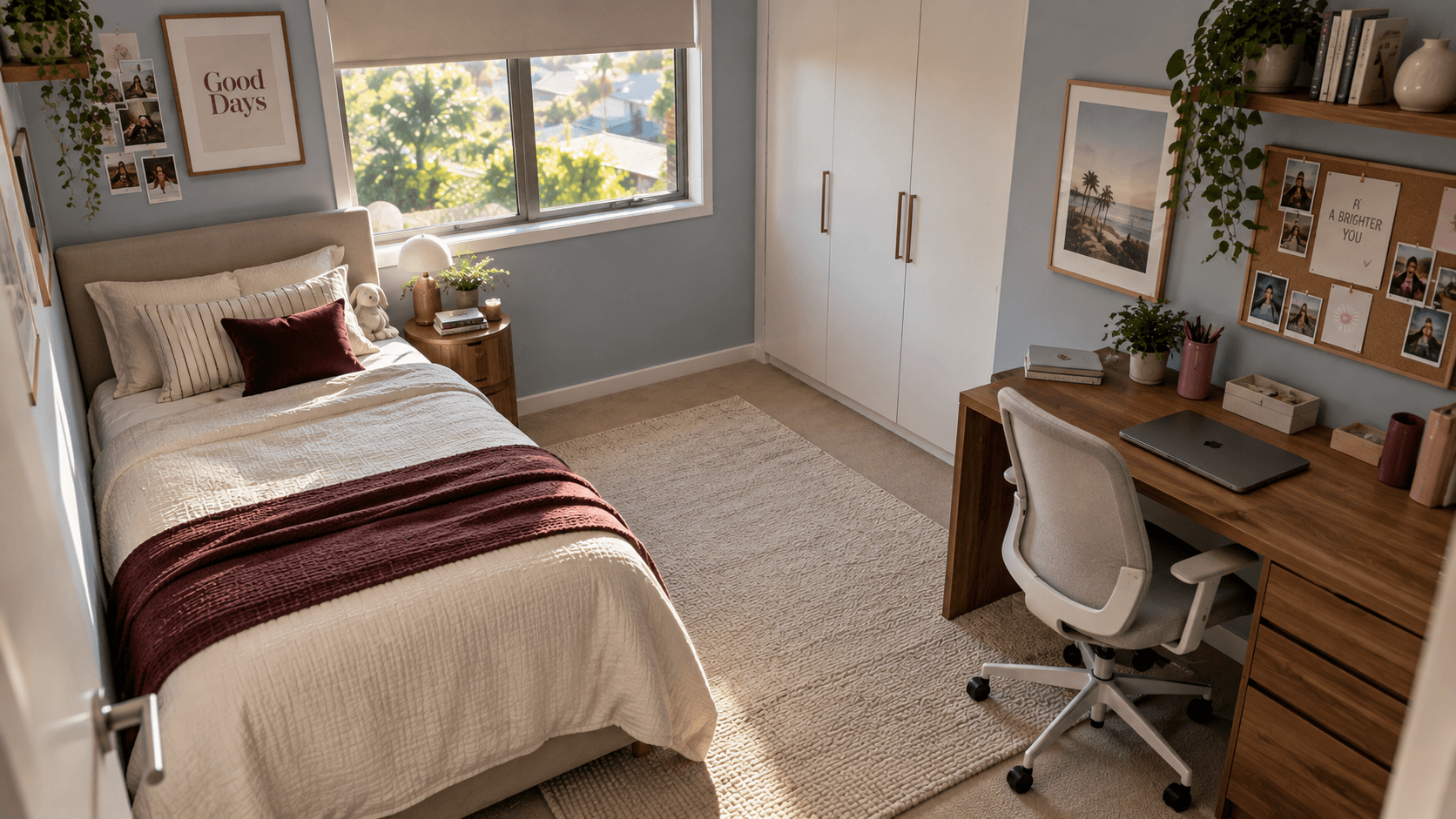
A king single at 1070 x 2030mm gives back 460mm of width and 0.93m². That sounds like nothing. It is the difference between a room that sleeps a teenager and one that also educates her and it is still a 2030mm adult-length bed she will not outgrow.
Where a queen genuinely works
| Room (robe included) | Area | What you get with a queen |
|---|---|---|
| 3.4 x 3.6m | 12.2m² | Queen, robe, desk, bedside table |
| 3.2 x 3.6m | 11.5m² | Queen, robe, desk. No bedside table. The threshold |
| 3.0 x 3.0m | 9.0m² | Queen, robe, bedside table. The desk goes |
| 2.7 x 3.0m | 8.1m² | Queen and robe, and a 520mm aisle under the minimum |

The brief behind this article states flatly that a queen bed can fit in a teen girl’s room. It can, and above about 11.5m² it should. Below that it fits the way a couch fits in a lift. Two Australian sources reach that threshold two ways: Zephyr + Stone call 3300 x 3600mm a “comfortable” secondary bedroom, and the Queensland Government’s Social Housing Design Guideline puts a queen only in Bedroom 1 at 11-12m², specifying “2 x single beds, 1 x desk” for Bedrooms 2 and 3. A government space planner working to minimums does not put a queen in a second bedroom, and the same maths applies to boys’ rooms.
Zoning, and why the desk wins

Zoning keeps the room organised and functional, and a teenager’s room serves as a bedroom, study and lounge space at once. Only one of those zones has hours attached. Scoresby Secondary College publishes what it expects of Year 12: “3 hours plus per weeknight with up to six hours on weekends.” That is 21 hours a week, roughly 840 a year, in one chair. The 460mm a queen takes buys unconscious time. It is not a close contest.
The desk height everyone quotes is a primary-school figure
The brief specifies a 533mm desk and 403mm seat for a 13-14 year old. The source is Australian but the page is written for primary students, and the numbers read as an inch conversion. A 533mm desk is coffee-table height.
Woods Furniture, which supplies Australian schools, puts secondary students at a 750mm desk with a 460mm seat and senior students over 183cm at 805mm and 500mm; AS/NZS 4442:1997 gives adjustable desks a 610-760mm range. She will grow through two size marks between Year 8 and Year 12, so buy a fixed 730-750mm desk $99 to $129 at Officeworks or Fantastic Furniture against $795 for a height-adjustable one and put the money into a chair adjusting 420-520mm. Size it honestly: the school standard top is 1200 x 600mm, but a laptop plus a second screen wants 1500 x 750mm, which is 12.5% of a 9m² room. A queen mattress takes 34.5%.
Storage: what “hidden” actually holds

Teen rooms often require maximising storage solutions, and multifunctional furniture is recommended to maximise space in small rooms. Just size the promises.
Gas lift beds provide hidden storage under the mattress about 200-250 litres under a queen, conservatively. Four suitcases, not a wardrobe. It also needs 600-900mm clear at the foot to open, which is the strip the desk wants, so a gas-lift queen and a desk are mutually exclusive in a small room. A king single gives 130-150 litres and keeps the aisle, from about $600 with drawers.
Storage ottomans can provide extra seating and organisation at modest scale: Bunnings’ $89.85 Artiss ottoman has a 920 x 360 x 210mm interior 69 litres, one doona and a 370mm seat that suits a reading perch, not a desk. A window bench can add seating and storage more convincingly, at $1,500-$5,000 built in with a 450mm seat.
Built-in bookshelves can double as clothing storage, and in a small space the case is better than it looks. Open shelves for folded clothes need 450-500mm of depth against a robe’s 650-700mm, and that 150mm is a fifth of the aisle you have been fighting for. It is cheaper too $450-$1,200 a linear metre against $1,110-$3,010 for a doored built-in and the trade is dust, which in a teenager’s room is a real trade. Smart organisation systems look good and are easy to maintain only if the small things live in baskets and drawers rather than on display.
One job regardless of style. Since 4 May 2025 the toppling furniture information standard has required warning labels on clothing storage and bookcases 686mm or taller and on entertainment units of any height. It mandates warnings, not anchors. The ACCC’s reason: “at least 28 people, including 17 children under five, have died” in Australia since 2000, with 900-plus injured a year. A tall leaning mirror, the fixture of every teen room photo online is not obviously captured by the standard. Anchor it anyway.
The layer she actually cares about
Contemporary design moves away from overly juvenile themes, and transforming a teenager’s space balances maturity with self-expression. Every Australian interior designer I found agrees on how: a neutral base with 1-2 accent colours, and all the personality in the cheap layer.
Colour palette

Neutral base colours allow for easy updates in decor and easy accessory changes later. Earthy tones can create a warm and inviting space, and Taubmans’ whole 2026 story is a palette called “Down to Earth” behind a green Colour of the Year, Team Spirit.
The brief says pastel colours like sage and blush create a calming atmosphere. Close. Dulux Australia’s 2026 “Ethereal” palette, styled by Bree Banfield, is “gentle greens, mauves, and blush pinks” pastel colours create a calm and timeless bedroom atmosphere, exactly as advertised but sage is Carlisle Homes’ word (“eucalyptus and sage tones”), not Dulux’s. Do not go looking for a Dulux colour called sage.
Bold jewel tones can add drama to a teen’s room, though no Australian source makes them the 2026 wall story; Dulux frames them as “dramatic accents of grape, blue and red.” A cushion, a velvet chair, a sign in neon. A calm base with bold accents reflects personal style in contemporary designs without committing a wall.
The designer consensus is tidy. Lynda MacDonald of The Design Chaperone: “We try to guide teens in the direction of using neutrals as their core selection.” Lana Taylor of Three Birds Renovations: “Create something that’s as perfect now as it will be in five years’ time,” because “the band they love this week won’t still be their favourite this time next year” so cushions and fairy lights are inexpensive to replace regularly, and that is where the fun money goes. Keep walls, carpet and curtains neutral; two sets of bed linen allow for easy style updates.
Wallpaper, decals and the 30-day rule
Wallpaper with subtle patterns can remain stylish over time, and wallpaper can be used for a stylish accent wall without committing four walls to a pattern chosen at 14. Removable wallpaper is ideal for renters wanting updates with written permission, and one rule that ruins most jobs.
Melbourne supplier Olive et Oriel: “New paint must cure for a minimum of 30 days before any self-adhesive product is applied.” 3M Australia says 28 days before using Command products on fresh paint. Two independent sources, one answer: paint first, wait a month, then stick anything to the wall.
The second trap is specific to Australian houses. Wash-and-wear and Teflon-additive paints sold for a child’s room precisely because they wipe clean repel adhesive. One Australian supplier states its product “is not recommended for application on ‘wash and wear’ or washable paints”; another warns those paints “can reject some wall sticker products.” Fabric-backed beats vinyl on a painted Australian wall, and a $4.99 sample tested for a week beats a $300 removal bill.
Gallery walls

Gallery walls enable easy rotation of wall art, which is the point in a room whose owner’s taste has a twelve-month half-life. Australian framers give real numbers: hang the centre at 1450-1520mm from the floor, leave 50-80mm between frames, sit art 150-250mm above a headboard, and keep the arrangement two-thirds to three-quarters the width of the furniture below. Treat the group as one shape. Command’s largest utility hook holds 6.8kg and will not work on brick or over wallpaper and mixing patterns in accent pieces adds personality without a single nail.
Fairy lights: the instruction nobody prints
String lights are the one great idea every list agrees on, and they are also a regulated electrical article. Decorative lighting is Level 1 in-scope equipment under the Electrical Equipment Safety System, built to AS/NZS 60598.2.20, and must carry the RCM which Energy Safe Victoria describes as “a small rounded black triangle with a ticked circle on the inside.”
Then the line that contradicts the entire genre. Energy Safe Victoria: “Always turn off decorative or Christmas lights before going to bed or leaving the house.” Not dimmed. Off. The regulator also names the safest option: “Use solar powered lights – LED or extra-low-voltage lights (5V, 12V or 24V).”
These do fail: LED String Net Mesh Fairy Lights sold by a WA supplier were recalled in 2023 for “serious and potentially fatal electrical defects.” ESV’s warning targets buying online from overseas sellers working to another country’s standards. Buy battery, USB or solar in person and check the packaging Kmart’s 100-pack solar set is $10 and Bunnings’ Lytworx 50-pack is $23.50, and neither online listing shows an approval mark, which is exactly the regulator’s point.
The hanging chair, and the ceiling it cannot hang from
A hanging chair is the most-photographed object in modern teenage girl bedroom ideas, and in an Australian house you generally cannot hang one. Bunnings’ moderated workshop is blunt: “roof joists are not designed to have the weight of a person and chair hanging off them,” and “I am unaware of any hooks that could be simply mounted on your existing ceiling.”
An Australian ceiling is a non-structural lining screwed to battens clipped to a prefabricated truss chord engineered to carry the ceiling’s own weight, not a person, plus the amplification of swinging. Done properly it means purpose-installed timber blocking, bolted, from the roof space: a tradesperson, not a Saturday.
The free-standing frame is the honest alternative at $249, and here is the surprise, its base is 1010mm across, 0.80m² nothing can share, closer to 1.96m² once you allow the swing arc. That is 22% of a 9m² room, more floor than the desk takes, and Australia’s one recall in this category was a free-standing egg chair withdrawn for “tipping or collapsing.” A compact armchair or a floor cushion buys the same lounge zone for a fraction of the footprint.
Layered lighting, on two switches

Layering different types of light enhances a room’s mood, and layered lighting is a hallmark of contemporary design but in a room that studies, it is functional. Beacon Lighting splits it cleanly: bedrooms want soft warm white at 2200-3300K, study zones cool white at 3300-5300K. Australian workplaces are designed to 320 lux for reading and writing, a sensible desk target even though no standard governs a bedroom. So: a cool-white desk lamp on its own switch, warm light everywhere else, the cool one off well before bed. Anything hardwired is a licensed electrician’s job in every state.
Sleep, which is what the room is for
Contemporary teen rooms emphasise distinct zones for sleeping, studying and relaxing, and layering textures creates a functional sanctuary that adapts to changing tastes. It also has to produce eight hours. The Longitudinal Study of Australian Children found about 25% of 12-15 year olds and 50% of 16-17 year olds miss sleep guidelines on school nights, with anxiety and depression symptoms more likely among them and, the bedroom-specific finding, 28% of 12-13 year olds with internet access in their bedroom fell short. The Sleep Health Foundation wants 8-10 hours and an ideal sleeping temperature of 17-19°C: in an Australian summer, blinds closed all day and a fan.
Be precise about screens. The Sleep Health Foundation says “we currently have no evidence that watching a TV in the hour before bed in the bedroom brings on sleep problems,” and a meta-analysis of 73 studies covering 113,370 people put the delay from device light at 2.7 minutes screens emit 80-100 lux where 1,000-2,000 is needed to shift a body clock. Yet the same Foundation says devices “should ideally be charged outside of the bedroom overnight,” and it is right: the mechanism is displacement, not wavelength. She is awake talking to friends, not bathed in blue. So design for the behaviour a charging spot in the hall, a cheap alarm clock on the bedside table, and a blockout that pulls fully clear of the glass each morning, because the guide that wants a dark room at night wants bright light in it at seven.
Let her design it, but split the decision

A mood board helps teens express their design preferences, and creating a mood board engages teens in the design process a shared pinboard, or cork above the desk. Teens have strong ideas about their room designs and Australian designers build that in. MacDonald: “Teenagers really have their own strong ideas on what they want their rooms to look like.” Bree Leech: “The colours that will work well are the colours your teen loves.” Chris Carroll sources base furniture, lighting, bedding and art, then lets the client “do the finer details themselves.”
Copy that split: the adult owns the expensive permanent layer, she owns the cheap visible one, which is where you add personality. Involving teens in design fosters their self-expression, letting teens choose removable decor keeps their space fresh, and collaborating on design can strengthen parent-teen relationships in a year when little else does. Raising Children Network is clear that privacy matters at this age knock. Its counterweight matters too: a room so cosy your child never leaves it is a signal to watch for, not a win.
What a bedroom makeover costs

A refresh paint, two sets of linen, string lights, lamps, cushions, frames is $700-$1,800. A mid update adding a desk, rug, blockout blind, feature wall and new bed is $3,000-$6,500. A complete fit-out with built-in joinery is $8,000-$20,000+, because a built-in robe alone runs about $2,060 a linear metre. Painting professionally has a median of $920 against $100-$200 and a weekend for doing it yourself; blockout roller blinds are $30-$60 off the shelf and $200-$500 installed. Set the budget by which layer you are buying, not by the room.
The short version
Measure before you shop, and discover what the room can hold before you decorate a bit of it. Under about 11.5m², take the king single and keep the desk 840 hours a year at one, eight hours a night in the other, and only one is negotiable. Keep the permanent layer neutral, earthy and grown up; let her mix in the wall art, the linen, the cushions and the light, inspired by whatever she is into this month. Anchor the tallboy, cure the paint for a month before anything sticks to it, turn the fairy lights off at the switch, and explore the inspiration with her rather than for her. Modern teenage girl bedrooms balance personal expression with flexible styles, which is a stylish way of saying the room has to make sense for both the teen girl she is now and the adult she is about to become. It is a great deal easier to change a cushion than to move a wall.