By
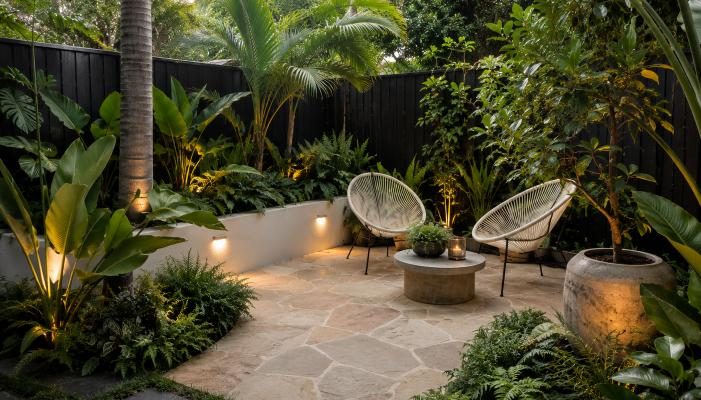
Most people searching for small tropical garden ideas are not in the tropics. They are in Sydney, Melbourne, Perth or Adelaide, looking at photographs of many lush tropical gardens shot in Cairns or Port Douglas, and wondering why the same plants sulk in their own backyard.
The reason sits in three Bureau of Meteorology numbers. Cairns averages 2,025mm of rain a year; Melbourne gets 575mm. Cairns sits at 66% relative humidity at 3pm in January; Adelaide is 36% and Perth 39%, roughly half, in the middle of the growing season. And Canberra’s mean July minimum is 0.1°C, which means the average winter night is at freezing.
None of that makes a tropical theme impossible. It just means the plant list, not the layout, is where these projects fail. What follows is the order it has to be built in Australia: microclimate first, then structure, then a palette sorted by how much climate each plant demands.
Your climate is the design brief

Australian gardening splits the country into five bands, and knowing which one you are in saves hundreds of dollars in dead plants.
| Zone | Winter reality | Where |
|---|---|---|
| Tropical | No frost, distinct wet season | Cairns, Darwin, Townsville, north Queensland |
| Subtropical | Frost rare | Brisbane, Gold Coast, Sunshine Coast, Coffs Harbour |
| Warm temperate | Cool winters, light frost, rare on the coast | Sydney, Perth, Adelaide, Wollongong, Newcastle |
| Cold temperate | Cold winters, some heavy frost | Melbourne, Canberra, Hobart, Geelong, Ballarat |
| Arid / semi-arid | Extreme summer heat, very high evaporation | Alice Springs, Mildura, Wagga Wagga |
Two things about frost. The Bureau treats 3°C in the screen as its frost indicator, because ground level runs colder than the thermometer, so a Melbourne or Adelaide garden averaging 7.5°C in July still gets frost on clear, still nights. And the damage is invisible until it thaws: water inside the cells freezes, expands and bursts them, and the plant looks fine until the sun hits it.
What the zone table cannot tell you is that a north-facing, wind-sheltered courtyard in Melbourne behaves like a different climate to the open lawn twenty metres away. Protected microclimates are the whole game.
Build the microclimate before you buy a plant
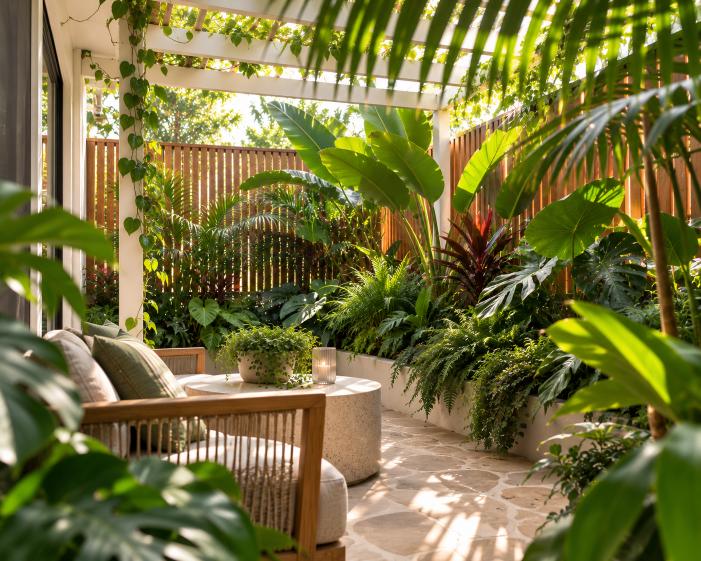
Tropical gardens thrive in warm, humid microclimates, and in most of Australia you have to manufacture the perfect microclimate rather than find it. This is the part of tropical landscape design that photographs badly and matters most.
Use the north-facing wall. Masonry and paving act as a heat bank, soaking up sun and radiating it overnight. That strip along a north or north-east wall is the warmest ground you own, and it is where the tender plants go. Sophie Thomson does exactly this in Adelaide, with a cooling counterweight of lawn or a water feature so the courtyard does not simply bake through an Australian summer.
Screen the wind, but do not wall it off. Agriculture Victoria’s shelter research puts the ideal barrier density at 40–60% cover, because “a very dense windbreak forces wind to be pulled down on the leeward side creating turbulence.” A permeable screen at around 40% shelters ground to at least 20 times its height; a solid barrier manages about 15. A slatted screen or planted hedge along the fence line beats solid Colorbond.
Put something overhead. A light upper canopy, a small tree, a pergola, shade cloth on the coldest nights, traps radiant heat and is the cheapest frost protection there is. It also gives big tropical leaves the filtered light they prefer.
Group your planting. Grouping raises local humidity and shades the soil, which is why a closely packed wall of foliage survives where three specimens dotted through mulch will not. It is also the look you are after.
Layering is what makes a small garden read as lush

Tropical gardens feature a layered planting structure, and in a small space that structure does double duty, it creates the jungle effect and it creates depth. Layering plants creates fullness and height in small gardens, which is what a larger garden gets free from sheer area. Key design principles for small tropical gardens come down to layering by height and choosing foliage over flowers.
Designing a small tropical garden involves using spatial tricks and vertical dimensions rather than floor area, and vertical layering helps create the illusion of depth in compact spaces. Work in three tiers:
- Upper canopy. In a small tropical garden, anchor the design with a tall focal point planted in the back, a tree fern, clumping bamboo, a lilly pilly pruned as a screen. Height at the rear stops the eye at a green ceiling rather than a fence.
- Mid-height. Layer textures by incorporating tall focal plants, mid-height groups and ground covers. Group plants in odd-numbered clusters of three to five for visual depth; planting in odd numbers creates a more natural look and enhances texture, because the eye reads even groups as deliberate and odd ones as grown.
- Ground cover. Fill every gap. Bare mulch between plants is what makes a small garden look sparse.
Large leaves in a small garden can create a more dramatic effect than smaller plants, the instinct to scale down is wrong. One monstera-sized leaf of bold foliage against fine fern fronds does more for a tiny bed than a dozen compact plants. That contrast is how you create texture, and pairing glossy leaves with matt ones will add texture again without a single new species.

Using vertical space with climbers creates the “jungle wall” effect in small gardens but choose carefully, because many classic tropical vines are environmental weeds here. Blue thunbergia is a restricted invasive plant in Queensland that cannot legally be given away, and madeira vine cannot be sold in New South Wales. Mounted elkhorns and staghorns are the safer wall option and need almost no ground water.
Using mirrors in the garden can visually expand the space and reflect light, and dense planting hides a mirror’s edges better than a formal garden does. Keep the sight lines honest, a mirror reflecting a doorway reads as a mistake; one reflecting green foliage creates depth.
The plant list, sorted by how much climate it needs
A tropical garden should include diverse plant species, but choosing plants with similar water and light needs simplifies maintenance enormously. Group by requirement, not appearance.
Amazingly hardy these work almost anywhere

These carry the look into cold temperate gardens where the real thing will not go.
- Soft tree fern (Dicksonia antarctica) – native from south-east Queensland to Tasmania, so it is the tropical-look plant genuinely native to Melbourne’s climate. Grows about 2.5cm a year, so buy the size you want.
- Gymea lily (Doryanthes excelsa) – 2–4m flower stems over a 2–3m clump, frost resistant foliage, drought resistant. The best big architectural substitute for Melbourne, Canberra, Adelaide and Perth.
- Lilly pilly – frost and drought tolerant, and prunable. Ozbreed’s narrow cultivars run 6–10m but hold at 1.5–2m with hard pruning: the backbone screening plant for a rainforest look in any southern capital.
- Clivia – 0.5m x 0.5m, tolerates drought and deep shade, and gives bright red-orange flowering plants under trees where nothing else performs.
- Cordyline australis – 3–6m, both heat and frost tolerant. Not the same plant as the colourful C. fruticosa everyone actually wants.
- Acanthus mollis, Fatsia japonica and hostas for big leaves in cool gardens; acanthus takes alkaline soil, which matters in Adelaide.
- Silver Falls (Dichondra argentea) – 10cm high, trailing 1.5–2m, drought hardy once established. A silver cascade over a wall or pot edge, and one of very few genuinely water-thrifty options here.
- Xanthorrhoea and agave for full sun, drought and alkaline soil. Both hold their shape beside a fire pit or paving where softer foliage scorches.
Warm pocket required

- Bird of paradise. Strelitzia reginae – the orange one everyone pictures, is 1.5m x 1m and tolerates light frost, drought and general neglect. It is the small-garden one.
- Bromeliads and Alcantarea. Alcantarea imperialis reaches 1.5m x 1.5m with a flower spike to 3m. Frost tender, but the best architectural plant for Perth and Adelaide because it wants almost no water.
- Native ginger (Alpinia caerulea) – 2–2.5m x 1–2m, heavy shade, not frost tolerant. Shell ginger (Alpinia zerumbet) is the more cold-adapted cousin.
- Cordyline stricta, an Australian native, 5m in the ground and 2–3m in a pot, very drought tolerant, frost tender but reshoots.
- Philodendron ‘Xanadu’ at 75cm–1m, and Philodendron ‘Hope’ at 1.5m x 1.5m, which tolerates near-freezing temperatures.
- Palms. Rhapis excelsa (lady palm) at 2–4m is the best true palm for a small shaded garden, though it burns in bright light. Walking stick palm (Linospadix monostachya) reaches 3m in a protected, shady, moist site. Kentia has the widest climate range of any palm here and is outstanding in a pot.
Get the sizes right, or skip them
Several of the most-photographed plants are traps in a small backyard.
- Giant bird of paradise (Strelitzia nicolai) reaches 4–10m tall and 2–4m wide. The claim that bird of paradise can grow several metres tall is true, of this species only, and it is far too big for a small garden.
- Elephant ears. You will read that elephant ear can reach 6 feet tall in ideal conditions. That is 1.83m, and it is an imperial figure from an American source. The Australian numbers are 1.5–2m for typical Alocasia, 60cm for dwarf forms, and 3–4m only in the tropics and the warmer climates of far north Queensland. Alocasia also contains calcium oxalate, and the Queensland Poisons Information Centre has recorded child fatalities, not a plant for a garden with toddlers.
- Canna lily. Canna lilies can grow up to 1.2 metres tall, and most Australian sources agree canna lilies reach heights of 1.2 metres, in their first year. Burke’s Backyard puts them at 1.8m in year two, and Canna indica reaches 2m. It is also an environmental weed in New South Wales and south-east Queensland.
- Heliconia – and yes, lobster claw is a heliconia, not a separate plant. “Heliconia can grow up to 2.5 metres tall” is right for H. rostrata ‘Parrots Beak’, the hanging lobster claw, but the genus runs 50cm to 4m in Australian nurseries. South of Brisbane it depends entirely on microclimate.
- Monstera can grow to incredible sizes in warm climates, 3m as a freestanding clump, 20m when it finds a tree. It is regarded as an environmental weed in parts of coastal New South Wales, and in a small garden it is the plant that eats the fence.
- Maidenhair fern is a diva, and there is no point pretending otherwise. The Australian native Adiantum aethiopicum reaches about 50cm, grows in every mainland state and Tasmania, wants shade and moisture, and dies down over winter, cut it back hard for fresh green leaves in spring.
- Golden cane, bangalow and cabbage tree palms all finish between 4m and 20m; Gardening Australia calls bangalows “10+ metre titans.” Cocos palm, though not legally restricted anywhere, is a documented killer of flying foxes and a weed problem on the NSW north coast. Leave it out.
Water features, and the two rules almost every article misses

Water features are essential for a tropical garden’s ambiance, and the reasons are real. Water features create calming sounds in tropical gardens, water features help reflect light and cool the environment, and the sound of moving water masks traffic noise in gardens, on a small suburban block that may be the biggest single thing you can do for the feel of the space. Water features are essential for creating a tropical paradise effect largely because they supply the sensory cue the climate does not. Two constraints.
Depth. In NSW, Victoria, Queensland, WA and SA, anything capable of holding water deeper than 300mm can meet the legal definition of a swimming pool and require a compliant barrier. Victoria and Queensland expressly exclude fish ponds and features used “solely or principally for ornamental purposes”; NSW, WA and SA guidance is silent. Stay under 300mm, or ring your council before you dig.
Victoria has a permanent statewide rule that all fountains and other water features must recirculate water, in force since 2011, and watering systems there can only run 6pm–10am. In Perth, sprinklers run on rostered days by street number, before 9am or after 6pm, with a winter switch-off from 1 June to 31 August and a $100 fine. Sydney Water asks for watering before 10am and after 4pm, but specifically exempts drip and smart irrigation from that window.
Cost is modest: a self-contained fountain starts around $49 at Bunnings, a decent cascading feature $150–$300, and a 10W pump running continuously costs $23–$38 a year. Installed, expect $105 for a small pond up to $2,800–$4,600 for a pondless waterfall kit. One health note, mosquito larvae need about a week of standing water, so empty any still feature weekly, and do not use mosquitofish; NSW Health’s medical entomologist calls Gambusia the plague minnow.
Soil, water and feeding

Tropical plants thrive in rich, organic soil, and in most Australian backyards you build that soil rather than find it. Bulk garden mix to AS 4419 runs about $126 per cubic metre in Sydney and $100 in Melbourne. Garden beds want 300mm of good mix minimum; raised beds are the practical answer over clay and let you build rich soil without excavating.
Organic matter is what holds moisture, it “turns the soil into a sponge,” as Sophie Thomson puts it, and soil health is what makes plant growth look effortless. If you use organic manure, age it first: Gardening Australia’s minimum is three to six months, because fresh manure burns roots.
“Mulch heavily to retain moisture in tropical gardens” is the one piece of standard advice worth correcting. Mulch does retain moisture, but Josh Byrne’s figure is 5–7cm for any organic mulch; beyond that you start excluding air and water rather than conserving them. Sugar cane mulch runs $17–$20 a bale for 22–26m², or $82–$110 per cubic metre in bulk. Two cautions: keep it off the stems, because collar rot kills the plant you were protecting, and note that fine mulches can go hydrophobic and shed water. Mulch works only when it is coarse and laid on already-damp soil.
Install a drip irrigation system for consistent moisture, a DIY kit is $49–$130 at Bunnings, installed systems $70–$1,000 with a median around $200. In a densely planted bed, drip lines under the mulch beat spray. Australian plumbing rules also require backflow prevention on external hose taps, so a dual check valve is not optional.
Self-watering pots help maintain consistently moist soil in tropical gardens and suit thirsty foliage plants, but they rot anything that wants to dry out between waterings, so keep succulents, bromeliads and strelitzia out of them.
On feeding, two products get confused. Seaweed solution is not a fertiliser. Seasol’s own description is “a complete garden health treatment,” and Gardening Australia notes these products are typically low in nitrogen and phosphorus, the value is in auxins, cytokinins and gibberellins, which act as tonics. Apply seaweed solution to strengthen tropical plants regularly, every two to four weeks, but pair it with a real feed. That is where slow release fertiliser earns its place: Osmocote All Purpose is NPK 21:0.5:6, about four tablespoons per square metre at planting or in early spring, feeding through the growing season. Go easy near natives, which are more phosphorus-sensitive than exotics.
How much water does a lush bed need? Agriculture Victoria’s benchmark for a dense, high-water garden in a 500–800mm rainfall zone is about 600 litres per square metre per year of supplementary water, against roughly 100 for a native garden. Six times the water, and it is a government figure, worth knowing before you commit an entire small backyard to the look.
Keeping it looking good, year round

Regularly prune dead leaves and spent flowers in tropical gardens, big-leaved plants look shabby fast, and removing brown leaves and spent flowers is most of what maintenance is. Seasonal flower rotation can refresh the garden’s appearance without long-term commitment: a tray of colourful foliage dropped into gaps twice a year does more than replanting the bed.
Dead palm fronds are the exception to enthusiastic pruning. Never remove green fronds, a Perth arborist’s line is that “green fronds are the tree’s engine room; cutting them off is like cutting its lifeline.” Take the brown ones once a year and leave the rest; professional palm pruning runs $95–$225 for a 4m palm.
In Melbourne, Adelaide and Canberra, budget for winter. Frost cloth is around $14 for a 0.9 x 20m roll, and an overhead canopy does the same job permanently. Sophie Thomson’s tip is worth stealing: apply seaweed before the cold arrives, one week ahead through the leaves, two to three through the roots, to improve frost resistance. And keep some leaf litter; dead material at the back of a border is doing more good than a swept bed.
What to expect
The best tropical garden ideas for a small Australian backyard are not the ones with the biggest leaves. They are the ones that match the plant to the climate you have, then use layering, odd numbers and natural materials to make a small space read as a tropical oasis rather than a collection.
A tropical backyard in Cairns is low maintenance because the climate does the work. The same look in Perth is an irrigated, mulched, fed and sheltered garden, and it is worth being clear-eyed about that before you start. Build the microclimate, choose plants that cope, plant them closely, and you can have a genuinely lush tropical garden in your own backyard in almost any Australian capital, it just will not be the plant list in the photograph.